Sunday, July 31, 2016

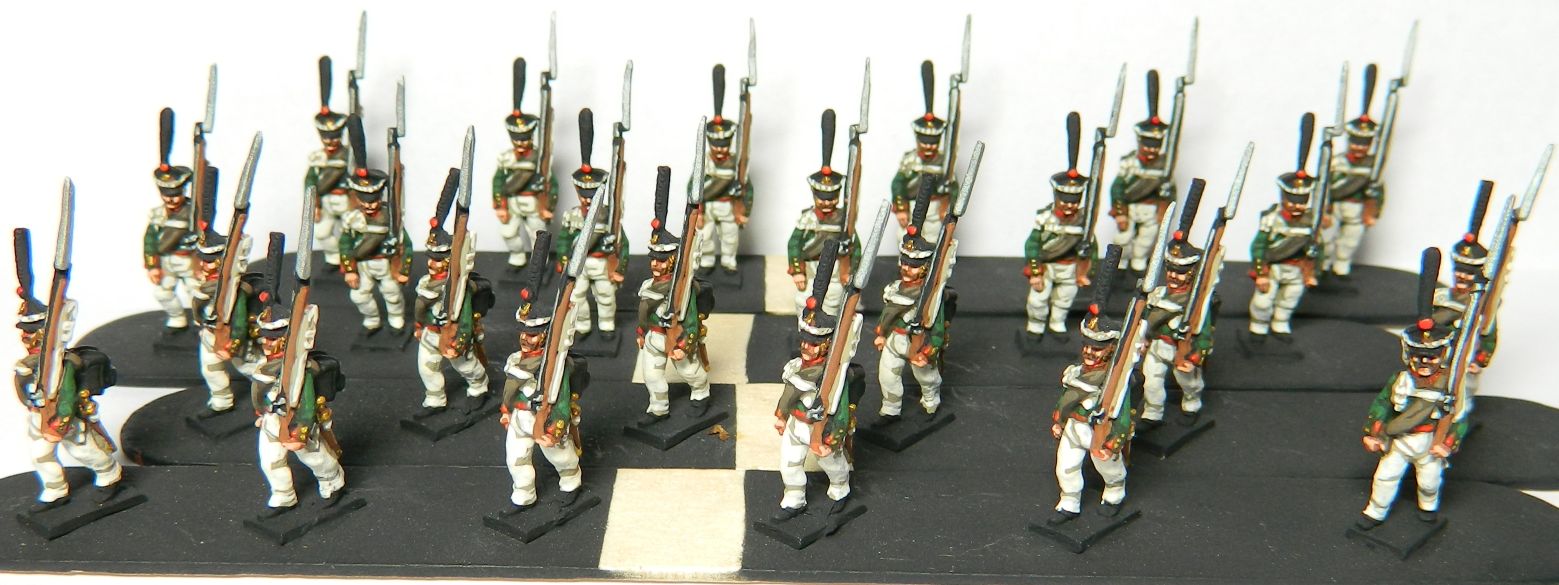
More Russian Grenadiers

These 24 advancing figures round out Glenn's Russian grenadiers.


Tonight I am prepping and priming the guard, jager, and militia.

Thursday, July 28, 2016

Giant Commission -- Russian Grenadiers

I was just able to finish these 126 grenadiers before July ended!  I still have 24 charging grenadiers to complete before I move on to the guard infantry and jager.


Monday, July 11, 2016

Giant Commission -- Russian Infantry Command

Last night I finished 60 more figures for Glenn's Russian army.  In addition to the last 6 musketeers, I was able to complete these 54 command figures.

First up are the standard bearers.  One has a bare pole as I wait for a flag.  All the flags are from GMB.


The officers look especially sharp.  Some wear grey overalls, and some wear the same stockings as the enlisted men.


The drummers were the trickiest to paint.  12 of them have shoulder wings, and I went ahead and painted the tooth design on the drum rims.


I have 150 grenadiers primed and ready to go!

Saturday, June 25, 2016

Giant Commission -- Russian Musketeers

These took a long time, but they are finally done.  Here are 228 Russian musketeers in the 1812 uniform.


I may have bitten off too many figures at once this time.  From here on out I'll try to keep my figure batches under 150!

Thursday, May 5, 2016

Painting Napoleonic Russians

Two readers, Bill and James, recently emailed with questions about my painting method and the color combinations I use.  Hopefully this post will help!

First, I usually prime black.  Any flat enamel paint will work.  I buy my cans of spray paint at Walmart for $.99 each.  The paint comes out in a this spray, so I usually apply two coats.  It dries extremely flat.

I block paint the figures in my shade colors.  They start off very dark, but I will add highlights to brighten them and make them pop.


Here are the colors I used for the block painting.

 Americana "Evergreen" for tunics and cockades; Delta's "Cayenne" for flesh; Delta's "Brown Iron Oxide" for facings, chin scales, brass shako and cartridge box badges, and scabbards; Delta's "Autumn Brown" for musket stocks; Delta's "Mudstone" for shako cords, musket slings, breeches, and belts; Delta's "Dark Chocolate" for blanket rolls; Delta's "Oyster White" for cockades; Vallejo's "Oily Steel" for canteens, musket lock, barrel, and bayonet; Vallejo's "Old Gold" for buttons and scabbard ends.

Craft paints do not have great coverage, but they work well over these shade colors.  I paint the highlights and leave recesses in the shade color.  This accentuates the figure's three-dimensionality and adds depth to the eye.


Here are the colors I used for the highlight painting.

Delta's "Oyster White" for shako cords, musket slings, belts, and breeches; Americana's "Forest Green" for tunics; Delta's "Toffee Brown" for scabbards; a mix of Delta's "Territorial Tan" and "Dark Chocolate" for blanket rolls; Delta's "Medium Flesh" for faces and hands; Vallejo's "Old Gold" for sword hilts, chin scales, and brass badges; Vallejo's "Flat Red" for facings.

Once the figures are all based, I will paint the shoulder straps in appropriate colors.

Hopefully this short guide is of some help!  I know this method enables me to paint a large number of figures relatively quickly while keeping a high standard.

Wednesday, May 4, 2016

Painting with My Four Year Old

A week and a half ago I loaded my seven year old son in the car and headed to Seattle for their annual model show.  My four year old daughter was sad to be left behind, but I promised her I would bring her back a present.  I picked up a box of 1/32 scale Marian legionaries from Italeri for her.  We spent the past few days painting up our first figures.

These figures are soft plastic, so model cement would not work on them.  I attached the pila and scuta with five minute epoxy.  I then primed the figures with flat white Krylon plastic primer from a rattle can.

I guided my daughter through block painting the figures.  First she watched me paint, then she copied what I had just done.  It took a few days, but she did a very tidy job blocking in the figure.

We then brushed on some Minwax Polyshades Tudor Satin and gave it a day to dry.  The stain did a very nice job shading the figures.  Then we painted on some flat clear acrylic paint, dullcoated the figures, and based them up.

My little girl is pretty pleased with how her figure turned out, and I am awfully proud of her.  My figure is on the left, and her figure is on the right.  They don't differ very much from each other, do they?


She has painted 1/72 scale plastics, but they did not turn out this nice!  I think some 1/32 scale skirmish gaming is in our future.  Do any of you know of some good rules?  Saga might adapt well to Caesar's Gallic campaign.